Horarium
The Hours of the Divine Office, kept by sun and season after the Rule of St Benedict
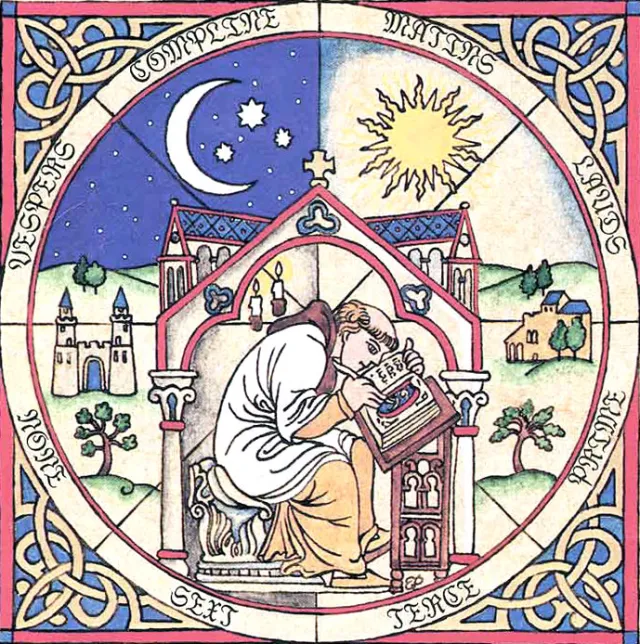
How the Hours are Reckoned
De horis dignoscendis
The Rule of St Benedict keeps no clock. It divides the daylight, from sunrise to sunset, into twelve equal hours, and the night into twelve more. Because day and night lengthen and shorten through the year, every Hour drifts against the modern clock with the seasons. This dial computes those temporal hours from the true sunrise and sunset of the time zone you choose, and marks which Office is kept at this moment.
Two points of the sun govern the whole round: Lauds is fixed to daybreak, and the evening is ordered so that all is finished while it is still light. The night Office is set backward from the dawn; Vespers and Compline forward from the dusk.
- Matins (Vigiliae) — kept in the depth of night, at the eighth hour of the night; reckoned as sunset plus eight night-hours (about two hours past midnight in winter, later in the short summer nights). Ch. 8
- Lauds (Laudes) — at first light; reckoned at sunrise. Ch. 8
- Prime (Prima) — the first hour of the day, as work begins; one day-hour after sunrise. Ch. 48
- Terce (Tertia) — the third hour of the day; anticipated to the second hour from 1 October to the start of Lent. Ch. 48
- Sext (Sexta) — the sixth hour, at midday. Ch. 41
- None (Nona) — the ninth hour; from Easter to 1 October said early, at the middle of the eighth hour. Ch. 48
- Vespers (Vesperae) — toward the eleventh hour, early enough that the evening meal ends in daylight. Ch. 41
- Compline (Completorium) — at nightfall, after the evening reading and before the night silence; one night-hour after sunset. Ch. 42
The seasons are the Rule's own. Easter is found by the Gregorian computus, and from it Lent and Pentecost; the fixed dates of 1 November, 1 October and 13 September mark the rest. The night rising and the brevity of summer nights follow of themselves from the temporal-hour scheme, so nothing need be set by hand.
A note on names: here Matins is St Benedict's night Office of Vigils, and Lauds the dawn Office he calls Matutini. Times are shown on the clock of the zone you choose; the sun's rising and setting are computed for a representative place within that zone.
✝ Explicit horarium. Soli Deo gloria. ✝